

Main benefits
of H2E technology
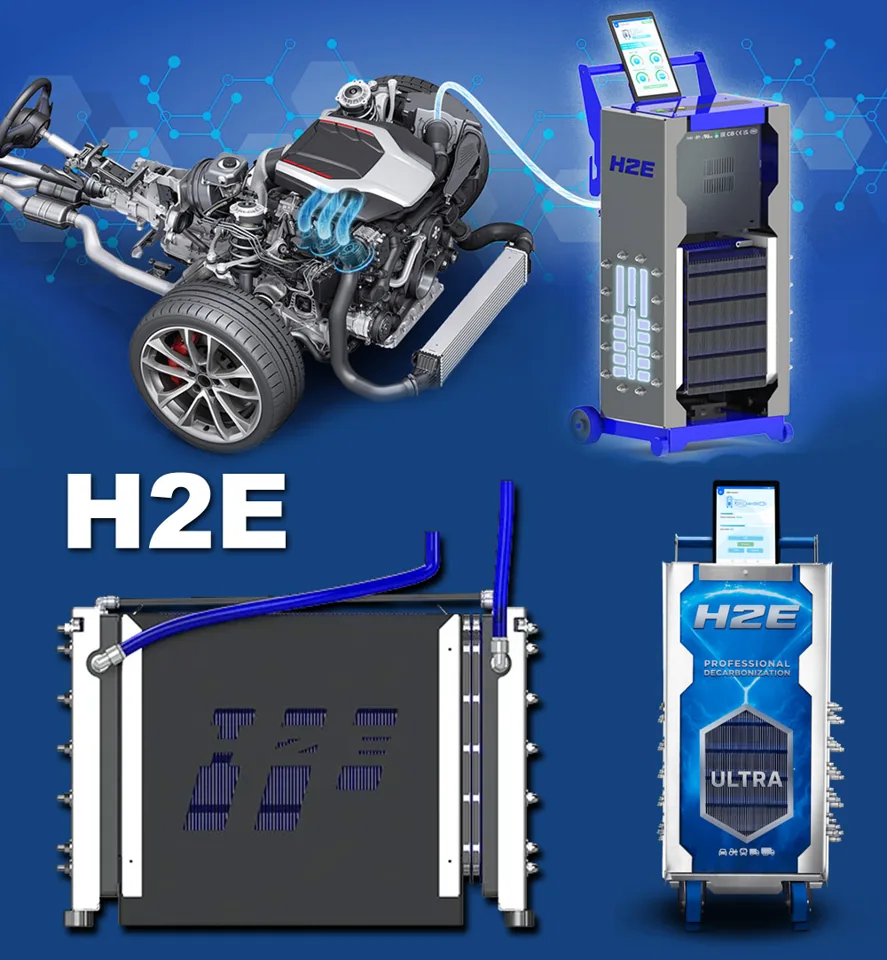
The H2E device and its advanced system make it easier to change the working medium and allow the fuel to burn more completely in the compression chamber.
We assess whether the treatment is suitable for your vehicle based on the engine and our findings.
Advanced electrolysis for maximum results
H2E is a modular system that optimises the conditions for water electrolysis to get the most from the resulting gas. H2E refers to a technology as well as the gas produced by electrolysis. Its developers drew on extensive expertise to devise a new way to produce and use hydrogen and oxygen gas of consistent quality.
A large team of specialists, supported by the scientific community and other experts, continues to research and develop H2E technology. The possibility of using the technology in a range of new products motivates further work.
How H2E addresses earlier technical problems
H2E addresses the challenge of designing a modular electrolyser whose cell stacks are easy to connect. The aim is to make the most of the system’s capacity without compromising gas quality, so that electrolysis delivers hydrogen, oxygen or another product in the quality and quantity required by the equipment it supplies.
Another question is how to control the duration of supply according to demand and keep the electrolyser’s operation consistent as electrical conductivity changes. The system adjusts the waveform and intensity of the current using information from a database or feedback from the equipment receiving the gas. Conductivity varies with factors such as the electrolyte level and composition, the number and material of the cells and the distance between the electrodes. The electrolyser has an analogue level gauge.
Water electrolysis device and process
The electrolyser is designed to produce hydrogen and/or oxygen gas while maintaining and repeating a set current waveform and intensity regardless of conductivity, the number of stacks or the number of cells per stack. An output controller regulates the gas quantity and quality for the equipment receiving it. The controller uses efficiency feedback or stored data to adjust the supply.
Output controller
An output controller lets the electrolyser use either a more concentrated electrolyte solution or a very dilute one to extend electrode life and maintenance intervals. Less expensive electrode materials may also be used if the electrolyser has a heater or the ambient temperature stays above freezing. The design lowers the freezing point and makes the electrolyser more resistant to low ambient temperatures, a common problem with other electrolysers.
Modular components
The modular electrolyser has one or more tanks, one of which may contain a dry filter housing. The modules support their own weight and make it easy to install cell stacks. The number of stacks depends on the required production capacity. Integrating the tanks into the unit avoids extra hoses, pipes and connections. In comparable electrolysers these extra fittings can create leak points, increase the overall size and require brackets, housings or special assembly.
Modular subassemblies
The design makes the cell stacks easy to connect in series, in parallel or in a combination of both, depending on the required capacity and intended electrolyser output.
Integrated water filter
The filter housing is built into the tank so it automatically separates condensate. The condensate and small amounts of electrolyte return through vertical channels between the tank and the filter housing.
Analogue level monitoring
The tank has an analogue gauge showing the minimum and maximum fill levels. Within that range, changes in the electrolyte level have only a minimal effect on the electrolyser.
Illuminated, easy-to-read scale
The analogue gauge has an illuminated panel with frosted areas that reflect light passing through the electrolyte. This makes the boundary between the liquid and gas easy to see when checking the electrolyte level frequently.
CELL PROPORTIONS that compensate for changes in concentration
The cell is designed so that the gasket’s height and thickness in relation to the effective electrode area compensate for an increase in electrical conductivity as the electrolyte level falls.
How the water filter works
The water filter produces gas with consistent humidity and temperature. It is an integrated module. As the unit cools, the vacuum that naturally develops in the electrolyser draws distilled water and traces of electrolyte back out of the gas. This uses less water, flushes the filter automatically and maintains a consistent electrolyte concentration between services.
Safety diaphragm plug
The filter is designed to vent pressure through a safety diaphragm plug if the gas in the filter ignites, while preventing flashback into the electrolyser.
Pressurised operation and variable pressure
The electrolyser can accommodate increased pressure through a restrictor or valve between the tank and the water filter. This is relevant for pulsed gas delivery, where a short increase in combustion intensity or more efficient release of gas bubbles from the electrodes may be needed. It is especially important when an application requires gas production above the rated capacity and the current must exceed its nominal value for the available electrode area.
Output controller
The electrolyser controller regulates the intensity and waveform of the current. This addresses variation in the electrolysis output and helps keep operation stable.
Compensating for voltage fluctuations
By supplying the electrolyser with a set current waveform and intensity, the design makes electrolysis independent of the power supply voltage. This matters because electrolysers have a strongly nonlinear current–voltage relationship, especially if current losses are negligible. Below the electrolysis threshold voltage, the current is very low. Above it, relatively small changes in voltage can significantly affect the current.
Optimising electrolyser output and energy use
The integrated tanks and filters distinguish this electrolyser from comparable designs. They make the design modular and repeatable. Together with the control method, this helps keep the unit compact without compromising output quality. The design and operating method use fewer additives and require less power and space.
Even, efficient cooling
Air-cooled electrodes provide the most efficient and even heat removal in this design. The solution was considered practical because it requires no additional circuit components and the cells can connect in the same way as in versions that do not require cooling.
Main functions of the output controller
The author identifies several advantages over the earlier designs they were aware of. These come from controlling the intensity and waveform of the current supplied to the electrolyser:
Controlling the current keeps it stable as electrolyser conductivity changes with temperature, voltage drops in the wiring or changes in electrolyte concentration. * Electrolysers that regulate hydrogen and/or oxygen production as described can work over a much wider temperature range than other devices of this kind. * The controller can alternate the power supply between two or more cell stacks. When each pulse takes up less than 50% of the pulse period, two or more stacks can take turns receiving a pulse within the same period. Each stack receives the same pulse sequence, offset by the duration of one pulse.
Operating mode
When additives are used occasionally, their quality and quantity and the operating mode of the equipment receiving the gas are important for optimising process time. The controller selects the equipment’s operating mode using stored data from comparable equipment or live feedback. If communication between the equipment and controller is disabled, the operator sets the mode using information on the control panel. The controller selects that mode based on equipment parameters from feedback or the database.
Address:
LS Multicars
Heinrich-Schicht-Straße 4a
42499 Hückeswagen
Contact
Tel.: 02192 9361636
Email: mail@ls-multicars.de
Opening hours:
Mon–Fri: 08:00–17:00
Sat: by appointment
Sun: closed